
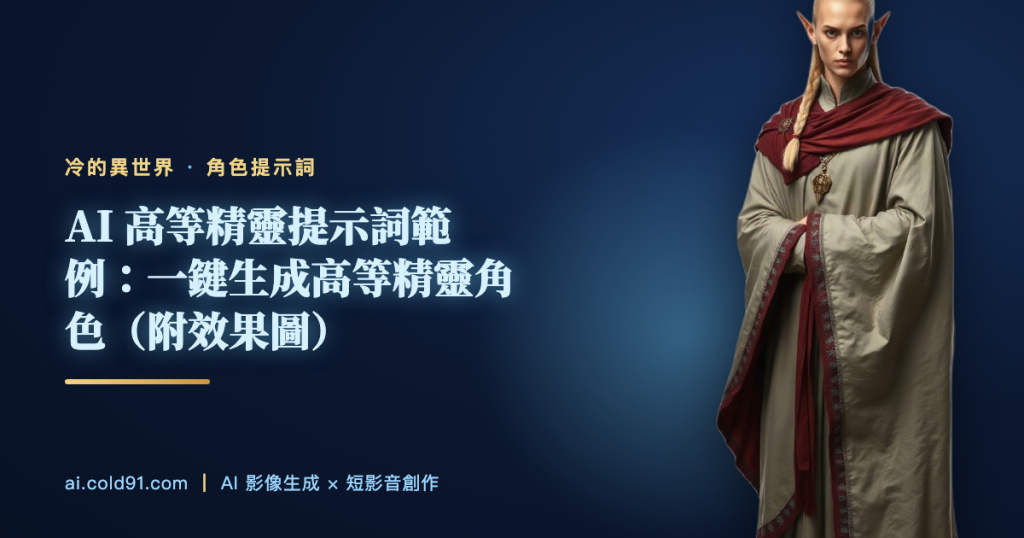
AI High Elf Prompt: Copy-Paste Example (With Sample Images)
This guide shows you how to generate a polished “High Elf” character with a single prompt — copy-paste ready, with a line-by-line breakdown and style variations.
🎯 Main Prompt (Copy & Paste)
Features: long pointed ears, blonde hair, blue eyes, ornate robes, elegant.
Scene: elven city, beams of light.
Lighting: soft golden light, cinematic.
Composition: half-body or three-quarter shot, 85mm lens, shallow depth of field.
Style: fantasy illustration, ultra-detailed, high quality.
🔍 Prompt Breakdown: Why It’s Written This Way
| Element | What this prompt uses | Why |
|---|---|---|
| Subject | High Elf | Naming the identity clearly first helps the model lock onto the right direction |
| Appearance | long pointed ears, blonde hair, blue eyes, ornate robes, elegant | Face, silhouette and outfit details decide how recognizable the character is |
| Scene | elven city, beams of light | The background carries the worldbuilding and mood |
| Lighting | soft golden light, cinematic | Lighting sets the texture and emotional tone |
| Camera | half-body or three-quarter shot, 85mm lens, shallow depth of field | Softens the background and pushes focus onto the character |
📜 Character Background
Few archetypes carry as much built-in drama as the High Elf. Its very existence raises the stakes of any scene it enters, and that’s exactly why it endures across so many stories.
Local legend holds that High Elf sightings are never random — every appearance means something has shifted, some balance has tipped.
It isn’t cruelty that drives the High Elf, but a set of rules only it understands. Most conflict comes down to outsiders failing to respect the line it has drawn.
Bedtime stories use the High Elf to keep children close to home at night — but nobody in this world is willing to bet it’s only a story.
Guild records treat any High Elf job as top-tier and high-risk for good reason: the failure count speaks for itself, and every new recruit reads it before signing on.
For storytelling purposes, the High Elf is at its best as an obstacle the hero can’t fully defeat the first time — a narrow, undignified escape is often more memorable than a clean victory.
Let it surface first through rumor and half-seen traces, and save the full reveal for later — that kind of pacing suits short-form, episodic storytelling especially well.
🎨 Variations
① High Elf Close-Up
② High Elf Full-Body Dynamic Pose
③ High Elf Dramatic Lighting
💡 Tips for Generating This Character
- If the face keeps changing, lock the “features” line and only change the scene and pose.
- To keep the same character across multiple images: generate one version you like first, then use it as a reference image and extend it with Nano Banana 2.
- You can switch art styles (realistic / anime / fantasy), but keep the High Elf’s key features intact or the character will lose its identity.
🤖 ChatGPT / DALL·E Version
You can also generate this with ChatGPT’s built-in image tool — no need to switch platforms. Just paste this into the chat:
🎬 12-Second Short-Video Script (Cold’s Isekai Universe)
Want to turn this character into a short video? Here’s a ready-to-use 12-second storyboard script in Cold’s Isekai’s signature deadpan-comedy style:
The camera cuts to Cold Cold’s face. Out of nowhere, the “High Elf” appears — every detail of its long pointed ears sharp and clear. Cold Cold barely reacts.
[DIALOGUE & ACTION]
High Elf: “You’re not even a little scared?”
Cold Cold: “Ow!” (jumps at first, then instantly returns to a deadpan expression)
[CLOSING NOTES]
No subtitles | End on Cold Cold’s signature cat-meow sound effect, quick fade out | Built for a fast 12-second cut
Frequently Asked Questions
Q1: Does this work with Midjourney / FLUX too?
Yes — paste it in as-is. Midjourney users can add –ar 2:3 –style raw at the end.
Q2: How do I keep the face consistent?
Lock the feature description, only change the pose and scene, and generate a few variations to pick the best one.
Q3: How do I turn this into a short video?
Once you have an image you like, drop it into Kling or Seedance and add a simple camera movement instruction to bring it to life.